
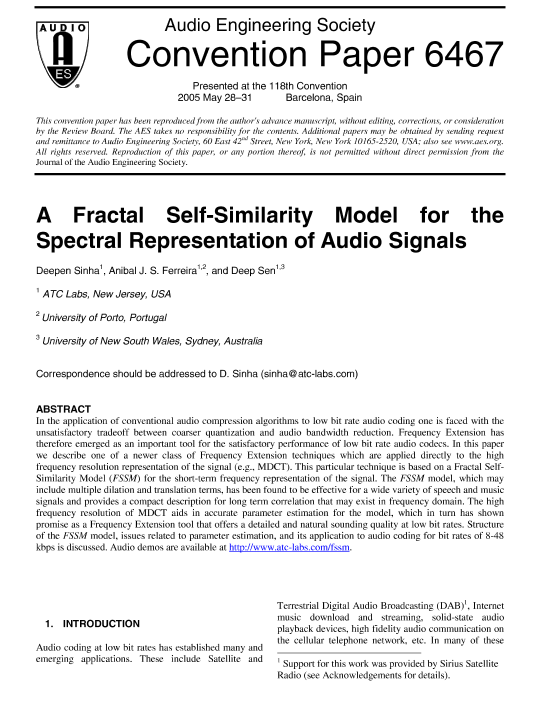
In the application of conventional audio compression algorithms to low bit rate audio coding one is faced with the unsatisfactory tradeoff between coarser quantization and audio bandwidth reduction. BandwidthExtension has therefore emerged as an important tool for the satisfactory performance of low bit rate audio codecs. In this paper we describe one of a newer class of Frequency Extension techniques which are applied directly to the high frequency resolution representation of the signal (e.g., MDCT). This particular technique is based on a Fractal Self-Similarity Model (FSSM) for the short-term frequency representation of the signal and takes advantage of the high frequency resolution of the MDCT, namely in terms of parameter estimation.. The FSSM model, which may include multiple dilation and translation terms, has been found to be effective for a wide variety of speech and music signals and provides a compact description for long term correlation that may exist in frequency domain.. The Structure of the FSSM model is presented, issues related to parameter estimation, and its application to audio coding for bit rates of 8-48 kbps are discussed.
https://www.aes.org/e-lib/browse.cfm?elib=13183
Click to purchase paper as a non-member or login as an AES member. If your company or school subscribes to the E-Library then switch to the institutional version. If you are not an AES member and would like to subscribe to the E-Library then Join the AES!
This paper costs $33 for non-members and is free for AES members and E-Library subscribers.
Learn more about the AES E-Library
Start a discussion about this paper!