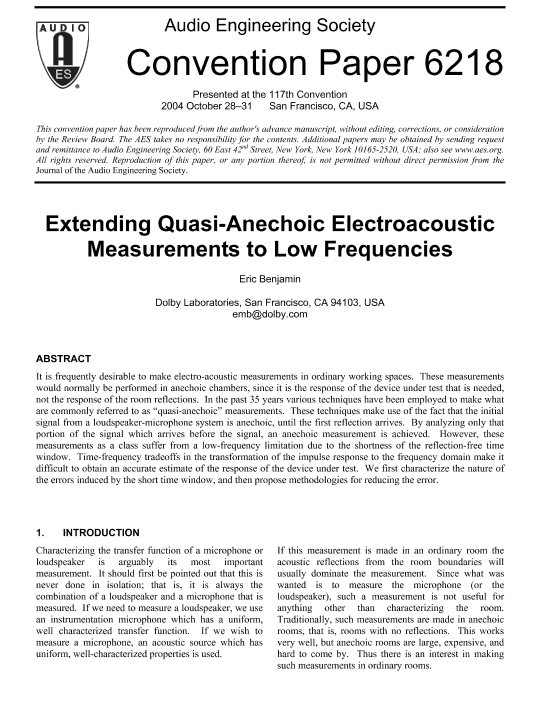
It is frequently desirable to make electro-acoustic measurements in ordinary working spaces. These measurements would normally be performed in anechoic chambers, since it is the response of the device under test that is needed, not the response of the room reflections. In the past 35 years various techniques have been employed to make what are commonly referred to as “quasi-anechoic” measurements. These techniques make use of the fact that the initial signal from a loudspeaker-microphone system is anechoic, until the first reflection arrives. By analyzing only that portion of the signal which arrives before the signal, an anechoic measurement is achieved. However, these measurements as a class suffer from a low-frequency limitation due to the shortness of the reflection-free time window. Time-frequency tradeoffs in the transformation of the impulse response to the frequency domain make it difficult to obtain an accurate estimate of the response of the device under test. We first characterize the nature of the errors induced by the short time window, and then propose methodologies for reducing the error.
https://www.aes.org/e-lib/browse.cfm?elib=12875
Click to purchase paper as a non-member or login as an AES member. If your company or school subscribes to the E-Library then switch to the institutional version. If you are not an AES member and would like to subscribe to the E-Library then Join the AES!
This paper costs $33 for non-members and is free for AES members and E-Library subscribers.
Learn more about the AES E-Library
Start a discussion about this paper!