
You are currently logged in as an
Institutional Subscriber.
If you would like to logout,
please click on the button below.
Home / Publications / E-library page
Only AES members and Institutional Journal Subscribers can download
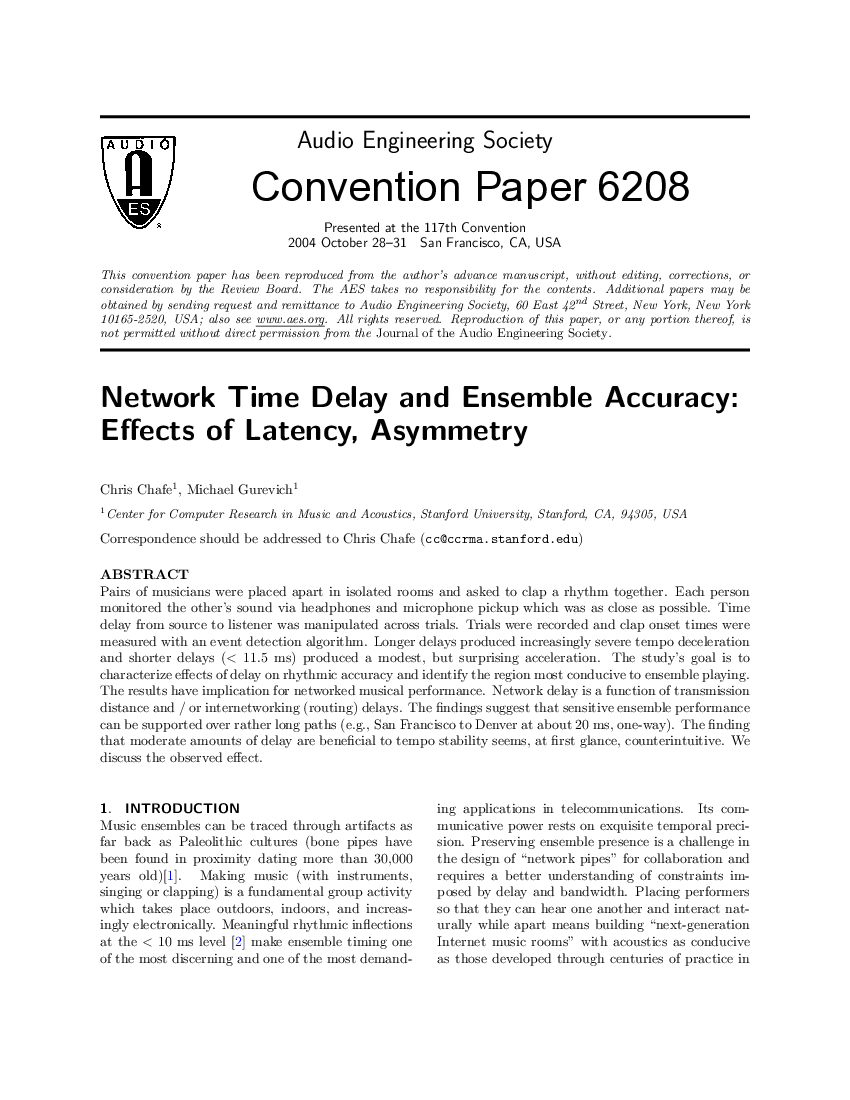
Pairs of musicians were placed apart in isolated rooms and asked to clap a rhythm together. Each person monitored the other `s sound via headphones and microphone pickup which was as close as possible. Time delay from source to listener was manipulated across trials. Trials were recorded and clap onset times were measured with an event detection algorithm. Longer delays produced increasingly severe tempo deceleration and shorter delays (<11.5ms) produced a modest, but surprising acceleration. The study `s goal is to characterize effects of delay on rhythmic accuracy and identify the region most conducive to ensemble playing. The results have implication for networked musical performance. Network delay is a function of transmission distance and/or internetworking (routing) delays. The findings suggest that sensitive ensemble performance can be supported over rather long paths (e.g., San Francisco to Denver at about 20ms, one-way). The finding that moderate amounts of delay are beneficial to tempo stability seems, at first glance, counterintuitive. We discuss the observed effect.
Author (s): Chafe, Chris;
Gurevich, Michael;
Affiliation:
Center for Computer Research in Music and Acoustics, Stanford University, Stanford, CA
(See document for exact affiliation information.)
AES Convention: 117
Paper Number:6208
Publication Date:
2004-10-06
Session subject:
Audio (including Telephony) Over Networks
DOI:
Click to purchase paper as a non-member or login as an AES member. If your company or school subscribes to the E-Library then switch to the institutional version. If you are not an AES member Join the AES. If you need to check your member status, login to the Member Portal.
Chafe, Chris; Gurevich, Michael; 2004; Network Time Delay and Ensemble Accuracy: Effects of Latency, Asymmetry [PDF]; Center for Computer Research in Music and Acoustics, Stanford University, Stanford, CA; Paper 6208; Available from: https://aes.org/publications/elibrary-page/?id=12865
Chafe, Chris; Gurevich, Michael; Network Time Delay and Ensemble Accuracy: Effects of Latency, Asymmetry [PDF]; Center for Computer Research in Music and Acoustics, Stanford University, Stanford, CA; Paper 6208; 2004 Available: https://aes.org/publications/elibrary-page/?id=12865
@inproceedings{Chafe2004network,
title={{Network Time Delay and Ensemble Accuracy: Effects of Latency, Asymmetry}},
author={Chafe, Chris and Gurevich, Michael},
year={2004},
month={oct},
booktitle={Journal of the Audio Engineering Society},
publisher={Paper 6208; AES Convention 117; October 2004},
number={6208},
organization={AES},
}
Notifications
