
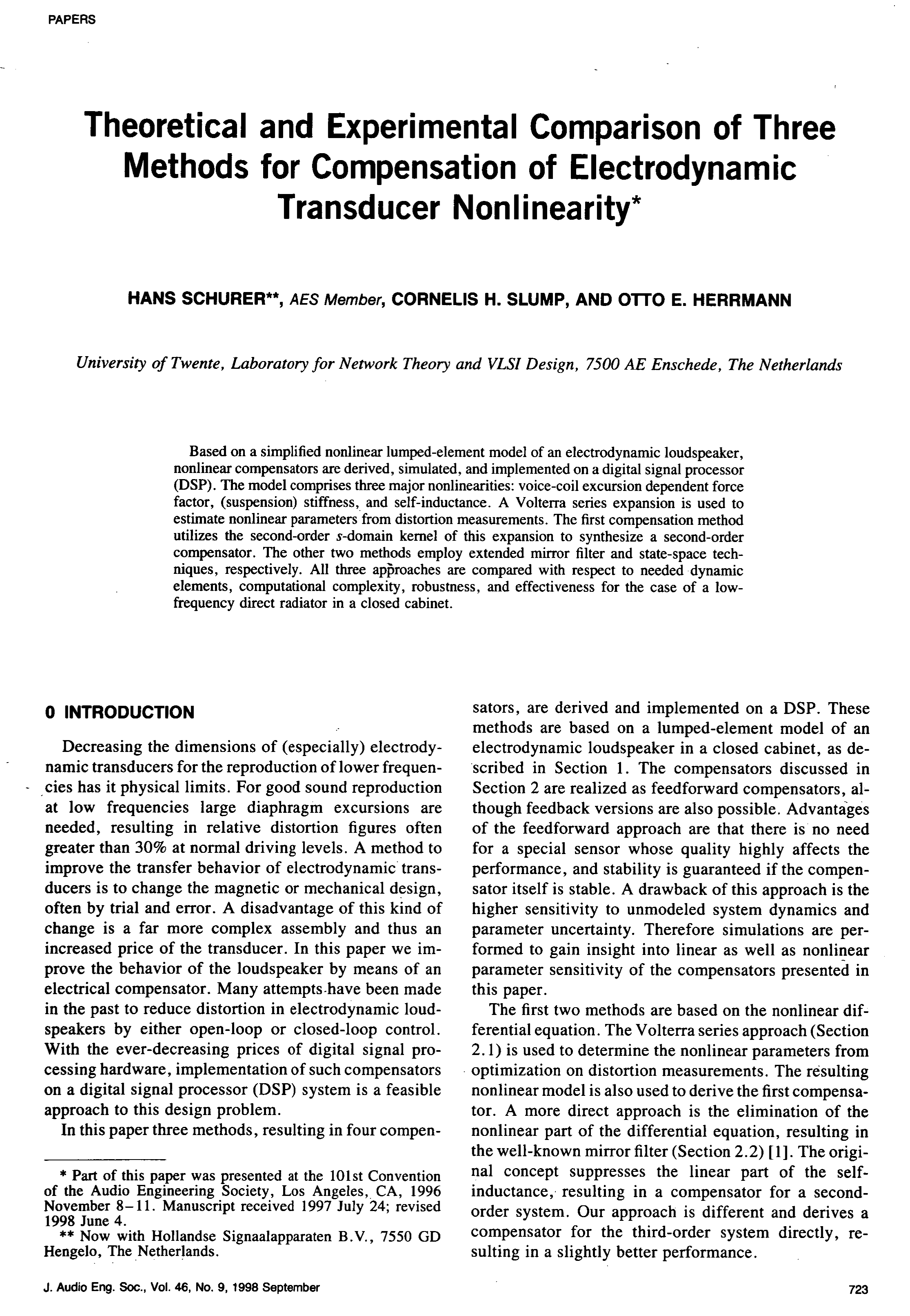
Based on a simplified nonlinear lumped-element model of an electrodynamic loudspeaker, nonlinear compensators are derived, simulated, and implemented on a digital signal processor (DSP). The model comprises three major nonlinearities: voice-coil excursion dependent force factor, (suspension) stiffness, and self-inductance. A Volterra series expansion is used to estimate nonlinear parameters from distortion measurements. The first compensation method utilizes the second-order s-domain kernel of this expansion to synthesize a second-order compensator. The other two methods employ extended mirror filter and state-space techniques, respectively. All three approaches are compared with respect to needed dynamic elements, computational complexity, robustness, and effectiveness for the case of a low-frequency direct radiator in a closed cabinet.
https://www.aes.org/e-lib/browse.cfm?elib=12134
Click to purchase paper as a non-member or login as an AES member. If your company or school subscribes to the E-Library then switch to the institutional version. If you are not an AES member and would like to subscribe to the E-Library then Join the AES!
This paper costs $33 for non-members and is free for AES members and E-Library subscribers.
Learn more about the AES E-Library
Start a discussion about this paper!