
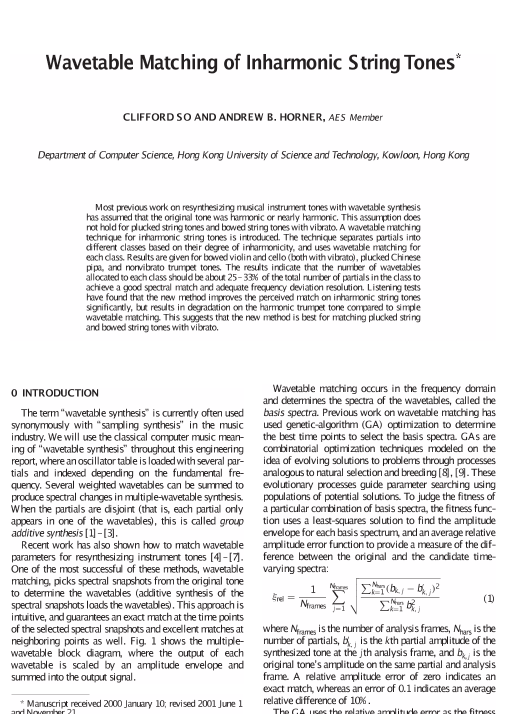
Most previous work on resynthesizing musical instrument tones with wavetable synthesis has assumed that the original tone was harmonic or nearly harmonic. This assumption does not hold for plucked string tones and bowed string tones with vibrato. A wavetable matching technique for inharmonic string tones is introduced. The technique separates partials into different classes based on their degree of inharmonicity, and uses wavetable matching for each class. Results are given for bowed violin and cello (both with vibrato), plucked Chinese pipa, and nonvibrato trumpet tones. The results indicate that the number of wavetables allocated to each class should be about 25-33% of the total number of partials in the class to achieve a good spectral match and adequate frequency deviation resolution. Listening tests have found that the new method improves the perceived match on inharmonic string tones significantly, but results in degradation on the harmonic trumpet tone compared to simple wavetable matching. This suggests that the new method is best for matching plucked string and bowed string tones with vibrato.
https://www.aes.org/e-lib/browse.cfm?elib=11093
Click to purchase paper as a non-member or login as an AES member. If your company or school subscribes to the E-Library then switch to the institutional version. If you are not an AES member and would like to subscribe to the E-Library then Join the AES!
This paper costs $33 for non-members and is free for AES members and E-Library subscribers.
Learn more about the AES E-Library
Start a discussion about this paper!